Tag: life

  • Just to Wind Up in the Dirt

    Abandoned buildings reveal how delicate silence is. As I walked through the decay, each drop of water was a point of order. Footsteps. Scratching. My beating heart preparing me to bolt for the doors. Even though I enjoy exploring these places, I’m like a rabbit waiting for a twig to snap. Perfectly still, but never at rest.

    I try to put myself in situations that reveal the insignificance of most of my problems. Ever since starting graduate school, my methods of coping have all taken cuts. My mind swirls down into abstractions in every quiet moment because of my struggles to write, exercise, and maintain my social life. Even if I’m proud of the life I’m living, I can’t let go of distractions. I’m never at rest, even when I should be.

    There is no clarity without confusion, no lotus without the mud. The painful echos of things left behind are growing faint on the horizon, but they survive.

    It’s a common prescription to get comfortable with being uncomfortable, but I take issue with the base assumption being made. I don’t know a single person I’d classify as comfortable. Many things—addictions, relationships, careers—enter the “comfort zone” because they are routine or familiar, not because they are comfortable. The “comfort zone” is a poorly named and awful place. Everything there may cause daily discomfort, but change would cause even more pain in the short term, leading people to accept false comfort. A person’s ability to adapt is their strongest asset and often their silent weakness.

    Through my attempts and failures, I’ve come to see the ideal scenario as finding comfort in recognizing and accepting discomfort. Once it is accepted as it is, the pain becomes a tool for that slow, long-term change that makes you more of the person you want to be.

    Disorientation has been my blessing over the past few months. While work has been suffocating, I’ve had the preciousness of time revealed to me through the tough choices I had to make. However, a line from Julian Baker has continually echoed throughout this process: “Spend your whole life getting clean just to wind up in the dirt.”

    No matter how in control I feel of things, I’ll end up in the dirt eventually.

    Being away from writing makes coming back a lot of fun. Thank you for reading my reflection. The end of “Our Place in the Ice” will be posted next week.

  • Intimacy with Failure

    At 4:45 on Wednesday I woke up and drove to Mount Rogers. After arriving at an isolated trailhead after four hours of driving, the hike seemed irrational. Fog was suffocating the mountain. I had no cell service, I wasn’t dressed for the rain, and I was frightened. I’d never hiked alone before.

    A fiction teacher I had described the ideal narrative structure of a short story as one where the character ascends a mountain and everything ends right at the summit. I’m inclined to think this story will be boring because I didn’t reach the top of Mount Rogers. I only ended up traveling seven miles out of a twelve mile hike, so I’ll keep this post short as a result.

    Around some nameless section of the trail that was almost completely overgrown, I leaned on my walking stick and looked out into the dense fog. I had an authentic opportunity to problem solve and be accountable to myself. Many stressors that come with daily life are only tangentially related to survival. It was a gift to be humbled by the present situation. So, I was honest with myself.

    My ankles were blistering badly. I didn’t know it yet, but for days I wouldn’t be able to run or wear shoes from the pain. Breaking in my mountaineering boots for future trips was a good idea, but their firm soles made maneuvering on the rocks difficult. I had already slipped multiple times and the rain was flooding parts of the forest. I thought to myself that having trouble with ascending was only spelling doom if I went further up. After all, going up is optional, and going down is mandatory. The risk of a brutal slip as I descended was increasing.

    However, the worst factor was that I was drenched. My tank top and shorts were a good idea, but not for long. All the extra layers I had in my bag to accommodate the elevation were wet and I was starting to shiver. Seventy degrees at the base of the mountain, and I was freezing.
    Everything to get a case of hypothermia in the summer was lined up: soaked, stuck in the wind, completely blocked from the sun, far away from medical help, and at an elevation where the weather can change rapidly. I also was fixated on the irony of my situation. Suffering hypothermia in the middle of the summer would be objectively embarrassing.

    I suffered a lesser but still grading humiliation as I descended. My mind was flying through justifications for failing to complete relatively simple challenge. Compared to my dream ascents, this was nothing. Even if turning around was the rational and safe decision, it still felt ridiculous. What does this say about me as a person to turn around and “accept defeat?”

    Strangely enough, I think this question was answered in a way that only experience can communicate, not artistic expression. As I walked down the trail, something cut through the monotonous sound of the rain. A tree had fallen somewhere down the mountainside. I couldn’t see it, but the crack echoed across the rocks. I paused for a moment to savor the lesson.

    That tree was much older than me. It had seen a lot more than me, and to my knowledge, nobody heard it fall but me. Everything made sense after the woods reminded me of my place.

    What does it say about me as a person that I “accepted defeat” and turned around? Nothing.
    I failed, but that’s it. The forest it still again.

    Did the tree “fail” by falling? At a certain point, laughter is the only way this question can be answered.

  • Measurements & Meaning

    Measurements & Meaning

    I’ve been reminded of landmarks because of my birthday. Increments of time that others feel like pointing out:

    “Ten years since ___.”

    “___ years since graduation.”

    “You were born ___ years ago.”

    These are often followed up with a sigh, a real “can you believe it?” kind of admission. Perceiving time is one of the few indications of being alive and yet it only seems to be seen in retrospect. It’s normal because being in the present—truly perceiving it without judgement—tends to offer nothing. It just “is.” This isn’t something that is easy to be comfortable with.

    If I’ve made one step of progress in my life, its having a much lower perception of myself. This isn’t to say that my self-esteem is low or that I hate who I am. Far from it. I’ve grown significantly from times in college where I saw my life as meaningless, my body as unworthy of persisting. Now, I possess a clarity of vision of who I am, what I deserve, what I want to do.

    A significant difference between those times and now is that I don’t perceive myself as easily as great, awful, or insignificant. The act of heightened perceiving—judging myself in the process of living—has lessened as I’ve come to understand the world.

    I’m getting closer to cutting the sentence down. “I am great” or “I am awful” just becomes “I am.” When the sentence you live in is shorter, time becomes richer.

    Yet, the measurements remain. Contradictions become rampant, and change continues to be the only constant. Right around the time of my birthday, I had to make a change to my self concept that bothered me more than it should have.

    It was a small thing, but I decided that I would need to choose between two sports that I love: tennis and endurance running. My dream was to compete in both of these sports as much as possible. Not necessarily to win events but to put myself in the most challenging scenarios. I want to race in marathons and ultra-marathons across the world, and I want to enter tennis tournaments and win difficult matches.

    As I put training sessions into my routine for both sports, my legs revealed the situation to me. Pursing both authentically to their natural conclusion would inevitably leave me too injured to compete in either. They are too high impact on my legs and I can’t reconcile my competitive nature with them. A clear indication of something my ego didn’t want: a limitation.

    Even though ___ is still young, it’s not as young as I was two or five years ago. The measurements sneak into my mind again and pull me into ego-fueled perceptions of myself. Distractions, seeking to calcify myself into something I am not, taking away the agency I have to make decisions. So, I had to see the moment for what it was: a sacrifice. That’s all it is.

    Once I saw it without the measurements, I found a deep satisfaction in making it. Death and I are playing chess and I saw the board clearly enough to make a move. I got to progress a little bit farther after recognizing my situation for what it was in the moment.

    I chose running. Tennis would have to take a backseat, even though I adored everything about it.

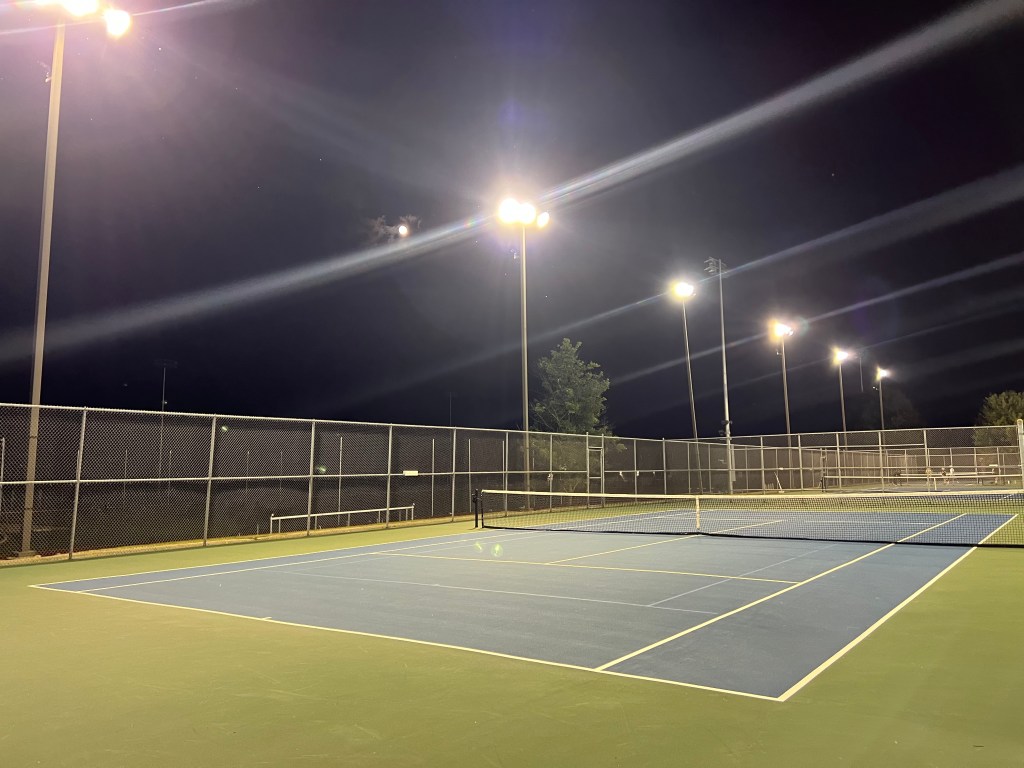
    Reflecting on one of my last practices, I remember being told to leave the court by the campus security because I had stayed after hours. I was hitting madly, slamming some of my best forehands into the backboard like my life depended on it. Tennis scoring was originally marked on a clock, the minute hand moving as each game neared its end. Time running out.

    As the distance grows between that last practice, I see more evidence of the lunacy that tennis engenders. A method of hitting a ball back and forth somehow served as the conditions to make a global sport. People collapsing from exhaustion, bursting into tears, working since childhood to put everything into a single shot. A modern non-violent gladiatorial sport where people play into the night, practicing for something with no real benefits for survival.

    Lines measured on the ground. Creating something from nothing, enough to make me spiral into a crisis over something as insignificant as hitting a ball back and forth.

    I look at white lines on pavement and see the outline of death. The only sane reaction is gratitude because the most beautiful game in the world would be impossible without it.