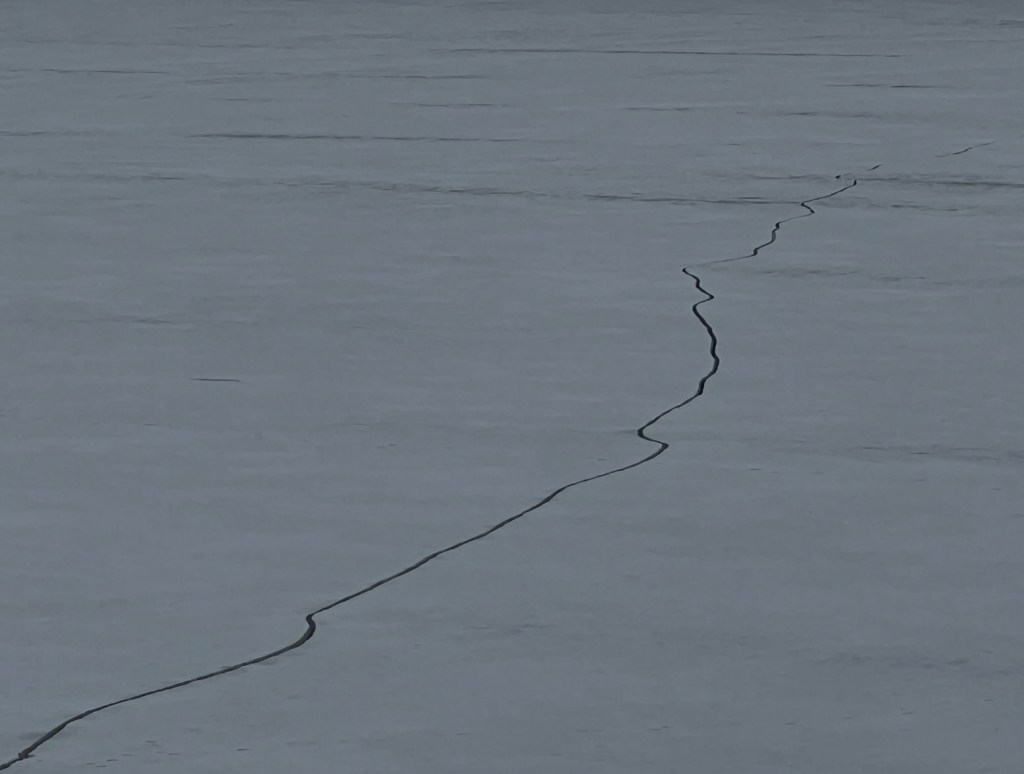
Abandoned buildings reveal how delicate silence is. As I walked through the decay, each drop of water was a point of order. Footsteps. Scratching. My beating heart preparing me to bolt for the doors. Even though I enjoy exploring these places, I’m like a rabbit waiting for a twig to snap. Perfectly still, but never at rest.
I try to put myself in situations that reveal the insignificance of most of my problems. Ever since starting graduate school, my methods of coping have all taken cuts. My mind swirls down into abstractions in every quiet moment because of my struggles to write, exercise, and maintain my social life. Even if I’m proud of the life I’m living, I can’t let go of distractions. I’m never at rest, even when I should be.
There is no clarity without confusion, no lotus without the mud. The painful echos of things left behind are growing faint on the horizon, but they survive.
It’s a common prescription to get comfortable with being uncomfortable, but I take issue with the base assumption being made. I don’t know a single person I’d classify as comfortable. Many things—addictions, relationships, careers—enter the “comfort zone” because they are routine or familiar, not because they are comfortable. The “comfort zone” is a poorly named and awful place. Everything there may cause daily discomfort, but change would cause even more pain in the short term, leading people to accept false comfort. A person’s ability to adapt is their strongest asset and often their silent weakness.
Through my attempts and failures, I’ve come to see the ideal scenario as finding comfort in recognizing and accepting discomfort. Once it is accepted as it is, the pain becomes a tool for that slow, long-term change that makes you more of the person you want to be.
Disorientation has been my blessing over the past few months. While work has been suffocating, I’ve had the preciousness of time revealed to me through the tough choices I had to make. However, a line from Julian Baker has continually echoed throughout this process: “Spend your whole life getting clean just to wind up in the dirt.”
No matter how in control I feel of things, I’ll end up in the dirt eventually.
Being away from writing makes coming back a lot of fun. Thank you for reading my reflection. The end of “Our Place in the Ice” will be posted next week.
Buck and Caitlin set out to recover the men inside the Eye as soon as possible the next day. But, they had a visitor.
Cold destroys the body, regardless if the person is alive or not. News regarding the Eye was released the night of Hal’s death to those connected to the bodies. The next morning, a woman arrived. She had all the gear she would need. She knew crevasse rescue, and she recounted her history as a ski instructor. According to the team, there was no reason to turn her down, especially since she was the sister of James Melendez, the man who first fell into The Eye.
I still had the day off, but I couldn’t resist knowing about the rescue as soon as it was over. Once they returned in the afternoon, I set out to join them at Caitlin’s house for dinner, hoping to hear everything about the mission. I arrived just in time to help Caitlin’s wife, Jeanie, pull a recently killed deer out of the back of her truck.
As dinner was being prepared, I took an audio recording.
Me: Alright, it’s on.
Buck: Do I look good?
Me: It’s just audio.
Jeanie: (yelling from the kitchen) The answer is no!
Buck: Aaaah I don’t think so. She right Davy?
David: Please don’t call me that.
Buck: What were we gonna talk about?
Caitlin: (bringing drinks to the table) The rescue with, uh, Sasha, from today. You feeling better, kiddo?
Me: Yeah.
Caitlin: Good, good. Okay, so, Sasha…
Buck: What was she, like, thirty?
Caitlin: Wasn’t much older than her brother. She had way more experience though. Smart too.
Buck: I don’t know if this is true, but it seemed like she raised him. You think that?
Caitlin: I can see it.
Buck: I took care of my siblings when I was a kid and you can tell when someone got that kind of maturity… wait, Jeanie what is this?
Jeanie: Uh, it’s an IPA from the brewery down the road. It’s good, right Cate?
Caitlin: Yeah! (shaking her head at Buck)
Buck: It tastes like batteries. Tell me it tastes like batteries, David.
David tastes it. He shrugs.
Buck: That’s a yes. The California boy can have it, right?
Me: Sure. (I pushed away a glass I had already emptied glass)
Caitlin: Jesus, you’re crashing on the couch.
Me: Fine. What was Sasha like?
Buck: You know, she’s a ski instructor from Anchorage so she’s all business and familiar with all the kind of stuff we do.
Caitlin: Very knowledgable. She asked all the questions she could, I guess, before the chopper ride in.
Me: What do you mean all she could?
Caitlin: Well, she didn’t want to know too much about her brother. She just wanted to know how to get him out, you know?
Buck: We landed and immediately set up a belay. We were confident about the ice holding so we got her in there quick.
Me: Her? She went in?
Buck: Trust me, I know. (he raised his hand in disbelief, looking at Caitlin)
Caitlin: She had a way about her. It took us a couple minutes to try and talk her out of it, but it wasn’t going to work.
Buck: I just said fuck it and radioed the rangers to see if we’d get in trouble.
Me: And?
Buck: They said they had no problem with us letting her in there as long as she got out, and she did.
Caitlin: Much quicker than we expected too.
Me: She didn’t stay in there long?
Buck: How long’d she stay in there David?
David: I’d say after her head dipped below the hole, she descended slowly for about thirty seconds. Then, she radioed back up.
Me: Why? Was she scared?
David: (shrugged)
Caitlin: Well, in the moment, we had no way of knowing. The radio malfunctioned and wasn’t carrying her voice. It was really quiet. We were lowering her down and suddenly we heard static.
Buck: When it came through we started to pull her up, just to be safe. When she came up, she didn’t complain.
Caitlin: She scrambled up the side, and, oh, that’s when I noticed what you noticed!
Me: What?
Caitlin: The ice. It was suddenly getting slippery. She had to slam her crampons hard into the side, and even then it only held for a second.
Buck: Wasn’t much of a problem since we just pulled her out quick, but yeah, she seemed to struggle with it.
Me: Did she say anything?
Caitlin: Well, when she stood up she started smacking the side of her flashlight.
Buck: She said it was broken.
Caitlin: Yeah. Looked like it was working fine to me, and then she was just quiet.
Me: Was she acting weird?
Buck: I don’t know what weird would be in this situation. Not being able to find your brother when you’re right above him is definitely weird, you know? She just… (he gestures at Catilin)
Caitlin: She didn’t say much on the way back.
Buck: Just looked at her feet.
Caitlin: Yeah. Poor girl. She said thank you when she left, but that was it. She was really meek when she said it too.
Buck: I won’t lie, it was heartbreaking. She seemed like a little kid. Wouldn’t look us in the eyes. The sun was setting and she was just sitting in her car as we left for the day.
Me: Damn.
Buck: I need another beer. Jeanie!
Jeanie: What? I’m not bothering the recording, am I?
Buck: Absolutely not, Ji Ji.
Caitlin: He’s just whining about another beer. He (she points at me) definitely does not need another.
Me: I don’t know what she’s talking about.
Caitlin: We can’t have him be a drunken idiot all the time!
Buck: What if we actually need his help out there?
Jeanie: I’ll see what I can do. (She points at me) Are you done encouraging my wife and her Indiana Jones fantasy yet?
Out of a passion for internet history and to get some much needed inspiration, I decided to peruse some old blogs. I put some of my own writing aside for the sake of sharing this one that I retrieved from the Internet Archive. It was published in the winter of 2001. I’ve taken the liberty of changing some real names to simple placeholders and cleaned up some grammatical errors (I may have missed some). I will post more entries as I continue to put them together. They are scattered, but I’ve taken to calling them “Our Place in the Ice.”
Entry #1
If we don’t know, we cannot react. If we can’t react, we cannot hope. When I discuss what I’ve seen with others, they dismiss the patterns and gesture at the great unknown to explain it all away. I’ve seen too much for the charity that comes with accepting the emptiness of it all. There is a path through the unexplainable, either towards understanding itself or the true limits. Fighting to know either one of them is terrifying. A life in the wild has required that I learn this.
I’ve been volunteering with the local rescue team for almost four years since I moved to Alaska. I’ve come to accept the necessary grit I need to push myself into the mountains, but also the compassion to hold my boundary with the earth. I’ve broken through too much snow to find it’s turned red, to witness an adventurer on their final date with nature. The one that’s always coming, and yet it’s the one they never expect. The piece of equipment most commonly left behind by the people we rescue is humility.
I was eighteen when I started. Since I was thirteen I was climbing at any place my bike could take me. I solo camped in the winter and read about survival skills by flashlight. When I was sixteen, I took my car and I soloed the mountaineer’s route at Mount Whitney. I told my PE teacher about it and my mom got a call from the school.
A welfare check. My greatest honor. She didn’t care, lucky for me. I took off from home and high school as soon as the law would let me.
I got a job in a lumberyard and pestered my way into being involved in the local rescue team. Observing, then record keeping, then carrying the gear. For the past year, I’ve been saving lives. Consistently too, which is what has made recent events so strange.
On Friday, September 20th, we got a call from some hikers about a skier who crashed into a crevasse. The afternoon weather was clear so we took the helicopter and confirmed it from above: half of a broken ski laying towards the bottom of a crevasse less than a quarter mile where the glacier met the mountainside.
The crevasse in question was substantial. Approximately twenty-five feet wide and sixty feet long. It formed a rippling blue oval that could reasonably conceal our helicopter if we landed inside. The walls converged about twenty feet in the glacier to form a jagged bowl with the basin covered in slabs of broken ice and snow. As we descended at a safe distance, my team observed a hole no more than five feet in diameter offset slightly from the center.
We dismounted the helicopter and approached the side with care. This crevasse hadn’t been seen by the team before, and the bottom being covered in snow and broken ice meant the skier didn’t see it either.
All of us had the same judgement: he rode over and broke through the snow ceiling, carrying enough force to crash through the slab of ice below, creating the hole. My thought, while morbid, was that his ski likely snapped trying to hold his weight as he dangled by his foot.
We didn’t know when he fell or if he was dead or alive, but we knew he was in that hole.
All four of us stood at the edge while our team leader, Buck, squatted at the edge and tightened the bandana around his helmet. He quietly surveyed the bowl below while the rest of us started unpacking some of the medical equipment on our backs. Caitlin, another volunteer like me, started yelling into the crevasse that help has arrived. No response.
“Pulley is almost ready,” Caitlin said to the team.
“Don’t bother,” Buck said. Out of all of us, he had the most experience with rescues. He’d worked as a ranger at Denali for years and recently started working as a trauma surgeon while volunteering for rescues with our team.
“Why?” she said. I turned to face them. Both had pulled off rescues together for years, and I rarely saw them out of sync. The ranger with us continued to prepare for a rope rescue. Buck waved his hand over the crevasse.
“The bottom is delicate. It was thin enough for someone to fall through, including us if we get close to those cracks around the hole. Even if we managed to lower ourselves in, I reckon the rope would get damaged being pulled against the sharp ice. If the weight broke any more of the sides, it’ll send someone swinging. We don’t know how deep it is in there.”
Caitlin looked pensive for a moment and then nodded. The ranger looked up from his work with a confused look on his face. Buck responded.
“I ain’t ruling it out yet, but it’s too risky from where we’re at.”
I decided to speak up.
“What if we got a ladder, laid it across, and descended from a right angle above the hole? It’d be more stable that way.”
Buck turned to me. “You’re getting less dumb by the day, son,” he said with a smile, “but it wouldn’t support the weight. Plus, it’d be too tricky.”
I nodded as Buck turned to the ranger.
“We know who’s in there?”
“A young guy named James Melendez checked in at the ranger station this morning. He was the only person skiing alone today.”
He raised his eyebrows, “When this morning?”
“‘Bout six.”
Buck looked back at the hole and stroked his beard.
“Anything else?”
I ended up interjecting something I heard one of the rangers say before we left for the helicopter.
“Apparently he’s wearing a full red Marlboro ski suit.”
“Shit,” Buck said, “I like him already. Let me tell you what, hand me one of the med kits, a headlamp, and a radio.”
In less than a minute, Buck had tied them all to the end of a rope and started lowering them into the crevasse. We all crouched at the edge as we watched it drop into the inky spot beneath us. Just as it fell in, Buck held the rope tight and raised his radio.
“James, we’re lowering aid to you. Give us a sign of your condition if you can. Stay strong down there. We’ll get you out.”
We heard nothing but the dying echo of Buck’s voice against the mountains. He lowered the supplies further.
“Yell as loud as you can for us, James. We’re close.”
After no response, Buck continued to let out slack and the pack descended further. After some time hearing nothing but the scraping of the rope, our eyes left the crevasse and watched pile of rope behind us. It was a hundred feet long, and it was getting smaller.
“Speak to me, son,” Buck said, quieter this time.
Sixty feet left and the silence continued. The snow felt colder, the mountains grew tighter. Forty feet, and the ranger turned around. He hung his head and said nothing. Twenty feet, and Caitlin turned to wave at the helicopter. The engine ripped through the air as Buck extended his arm out into the crevasse, the tip of the rope in his palm. I looked at him and saw his eyes staring blankly into the wall of ice. Without saying a word, he began pulling the rope back up.
The team was quieter then usual on the ride back, especially me. The others were used to tragedies coming from people not taking the right safety measures. A part of them undoubtedly saw James as a fool, and if I’m being honest, I did too. I just tend to feel more pain for people like them. It wasn’t long ago that I was one of those guys going out alone into the wild. I never made a wrong move, or maybe I just got lucky, but I know now how vulnerable I was.
All I could think about was that guy lying beneath us. I knew with the depth of that chasm he was dead, but I hate that we left him in the dark and in that cold. At least we couldn’t hear anything, I thought to myself. We didn’t hear him suffer. I shuddered and sunk into my seat, watching the mountains get smaller in the window.
Caitlin quickly saw how I was feeling. She put her arm around my shoulder and I felt some of the weight melt away. She worked as a nurse for decades before volunteering and knew how to care for people better than any of us. You could tell by looking at her that the wrinkles on her face were chiseled by years of kindness. Buck, on the other hand, took off his glove and smacked my knee with it. I looked up and saw him smiling, giving me a thumbs up. I smiled too. We often couldn’t communicate easily over the noise of the helicopter, but we always found a way.
We contacted the family members we could at the station but couldn’t do much more. More rangers eventually assessed the situation and determined retrieving the body was too risky. The ice was too fragile but since we knew where James was, we would check the location often and reassess whenever we could. The crevasse stuck out visibly to anyone traveling around it and warnings were issues to all visitors. Little more was disclosed other than informing people that a fatal accident took place there and traveling near it was dangerous. It was marked on our maps and because of the shape the ice took, we took to calling it The Eye from then on.
For almost a month everything went as usual. Over the past season the team started trusting me to address medical issues and I helped bandage an exposed break in a snowboarder’s leg. Being only a high school grad meant I didn’t have a lot of options for learning this stuff, but Caitlin, when she wasn’t volunteering, worked as a biology professor. She encouraged me to sit in on her lectures and it inspired me enroll in community college. I’m planning on applying to med school soon, and keeping at is has made the previous failed rescue attempt less painful. I focused on looking forward.
At 4:45 on Wednesday I woke up and drove to Mount Rogers. After arriving at an isolated trailhead after four hours of driving, the hike seemed irrational. Fog was suffocating the mountain. I had no cell service, I wasn’t dressed for the rain, and I was frightened. I’d never hiked alone before.
A fiction teacher I had described the ideal narrative structure of a short story as one where the character ascends a mountain and everything ends right at the summit. I’m inclined to think this story will be boring because I didn’t reach the top of Mount Rogers. I only ended up traveling seven miles out of a twelve mile hike, so I’ll keep this post short as a result.
Around some nameless section of the trail that was almost completely overgrown, I leaned on my walking stick and looked out into the dense fog. I had an authentic opportunity to problem solve and be accountable to myself. Many stressors that come with daily life are only tangentially related to survival. It was a gift to be humbled by the present situation. So, I was honest with myself.
My ankles were blistering badly. I didn’t know it yet, but for days I wouldn’t be able to run or wear shoes from the pain. Breaking in my mountaineering boots for future trips was a good idea, but their firm soles made maneuvering on the rocks difficult. I had already slipped multiple times and the rain was flooding parts of the forest. I thought to myself that having trouble with ascending was only spelling doom if I went further up. After all, going up is optional, and going down is mandatory. The risk of a brutal slip as I descended was increasing.
However, the worst factor was that I was drenched. My tank top and shorts were a good idea, but not for long. All the extra layers I had in my bag to accommodate the elevation were wet and I was starting to shiver. Seventy degrees at the base of the mountain, and I was freezing. Everything to get a case of hypothermia in the summer was lined up: soaked, stuck in the wind, completely blocked from the sun, far away from medical help, and at an elevation where the weather can change rapidly. I also was fixated on the irony of my situation. Suffering hypothermia in the middle of the summer would be objectively embarrassing.
I suffered a lesser but still grading humiliation as I descended. My mind was flying through justifications for failing to complete relatively simple challenge. Compared to my dream ascents, this was nothing. Even if turning around was the rational and safe decision, it still felt ridiculous. What does this say about me as a person to turn around and “accept defeat?”
Strangely enough, I think this question was answered in a way that only experience can communicate, not artistic expression. As I walked down the trail, something cut through the monotonous sound of the rain. A tree had fallen somewhere down the mountainside. I couldn’t see it, but the crack echoed across the rocks. I paused for a moment to savor the lesson.
That tree was much older than me. It had seen a lot more than me, and to my knowledge, nobody heard it fall but me. Everything made sense after the woods reminded me of my place.
What does it say about me as a person that I “accepted defeat” and turned around? Nothing. I failed, but that’s it. The forest it still again.
Did the tree “fail” by falling? At a certain point, laughter is the only way this question can be answered.
I’ve been reminded of landmarks because of my birthday. Increments of time that others feel like pointing out:
“Ten years since ___.”
“___ years since graduation.”
“You were born ___ years ago.”
These are often followed up with a sigh, a real “can you believe it?” kind of admission. Perceiving time is one of the few indications of being alive and yet it only seems to be seen in retrospect. It’s normal because being in the present—truly perceiving it without judgement—tends to offer nothing. It just “is.” This isn’t something that is easy to be comfortable with.
If I’ve made one step of progress in my life, its having a much lower perception of myself. This isn’t to say that my self-esteem is low or that I hate who I am. Far from it. I’ve grown significantly from times in college where I saw my life as meaningless, my body as unworthy of persisting. Now, I possess a clarity of vision of who I am, what I deserve, what I want to do.
A significant difference between those times and now is that I don’t perceive myself as easily as great, awful, or insignificant. The act of heightened perceiving—judging myself in the process of living—has lessened as I’ve come to understand the world.
I’m getting closer to cutting the sentence down. “I am great” or “I am awful” just becomes “I am.” When the sentence you live in is shorter, time becomes richer.
Yet, the measurements remain. Contradictions become rampant, and change continues to be the only constant. Right around the time of my birthday, I had to make a change to my self concept that bothered me more than it should have.
It was a small thing, but I decided that I would need to choose between two sports that I love: tennis and endurance running. My dream was to compete in both of these sports as much as possible. Not necessarily to win events but to put myself in the most challenging scenarios. I want to race in marathons and ultra-marathons across the world, and I want to enter tennis tournaments and win difficult matches.
As I put training sessions into my routine for both sports, my legs revealed the situation to me. Pursing both authentically to their natural conclusion would inevitably leave me too injured to compete in either. They are too high impact on my legs and I can’t reconcile my competitive nature with them. A clear indication of something my ego didn’t want: a limitation.
Even though ___ is still young, it’s not as young as I was two or five years ago. The measurements sneak into my mind again and pull me into ego-fueled perceptions of myself. Distractions, seeking to calcify myself into something I am not, taking away the agency I have to make decisions. So, I had to see the moment for what it was: a sacrifice. That’s all it is.
Once I saw it without the measurements, I found a deep satisfaction in making it. Death and I are playing chess and I saw the board clearly enough to make a move. I got to progress a little bit farther after recognizing my situation for what it was in the moment.
I chose running. Tennis would have to take a backseat, even though I adored everything about it.
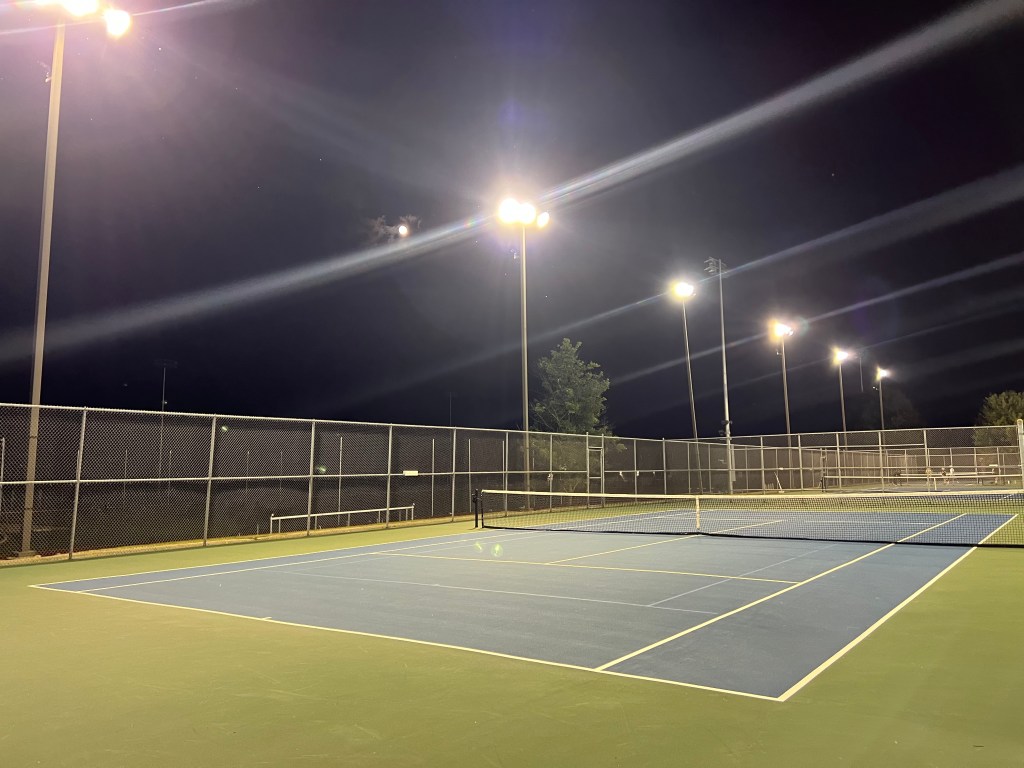
Reflecting on one of my last practices, I remember being told to leave the court by the campus security because I had stayed after hours. I was hitting madly, slamming some of my best forehands into the backboard like my life depended on it. Tennis scoring was originally marked on a clock, the minute hand moving as each game neared its end. Time running out.
As the distance grows between that last practice, I see more evidence of the lunacy that tennis engenders. A method of hitting a ball back and forth somehow served as the conditions to make a global sport. People collapsing from exhaustion, bursting into tears, working since childhood to put everything into a single shot. A modern non-violent gladiatorial sport where people play into the night, practicing for something with no real benefits for survival.
Lines measured on the ground. Creating something from nothing, enough to make me spiral into a crisis over something as insignificant as hitting a ball back and forth.
I look at white lines on pavement and see the outline of death. The only sane reaction is gratitude because the most beautiful game in the world would be impossible without it.